The rules
The full summary, with the booklet’s diagrams, to read before a game or settle a question at the table. The printed booklet in the box is the reference.
The aim of the game
The aim of the game
Each player runs a team of three to six riders: sprinters (green helmet), rouleurs (blue helmet) and climbers (yellow helmet). The stage crosses sections: flat, sprint, climb, and ends at the finish line.
Four medals are at stake: best cyclist (first across the line), best sprinter (first to finish the sprint section), best climber (first to finish the climb section) and best team (most points in the finish ranking). The player with the most medals wins the “Best Mind Cycling Manager” trophy. On a tie, the best team medal decides.
 Best cyclist
 Best sprinter
 Best climber
 Best team

Setting up
Setting up
Each player picks a team of three to six riders: three for a short game, six for a long one over the whole course. Rouleurs (blue helmet) ride on a blue base, the others on a black base.
The players build the stage with the removable tabs, set between two rows of squares: blue at the start of a flat section, green at the start of the sprint, yellow at the start of the climb, the double white line at the finish. A section ends where the next one begins. The medals go on their spots on the board.
The first tab marks the real start. The zone between the START line and that tab counts as flat, and it must hold every rider: with 36 riders, the first tab goes between rows 8 and 9.
The least experienced player, or the youngest, places a first rider on any square before the real start; then the player on their left, and so on. In that zone, two riders of the same team are not placed one behind the other.
- Startstart zone, on the flat
- Flatblue tab: the real start
- Sprintgreen tab
- Flatblue tab
- Climbyellow tab
- Finishdouble white line
The turn
The turn
A turn is every rider on the board moving once. The rider leading the race goes first, then the second, and so on to the last. On a tie, the one on the left goes first (the rider’s left).
You do not play by player but by rider: a player whose riders are spread out plays several times in the same turn, at different moments.
Everything is assessed before the turn starts: each rider’s section, the wind, the trains, the bottles, the fatigue.
The only exception to the order: the wheel and the relay. The rider following in a train plays right after the one in front, with priority over the others.
Movement
Movement
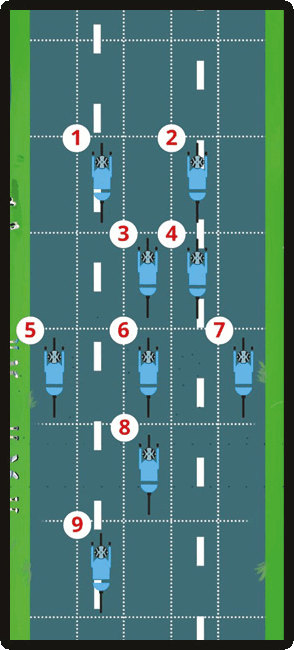
A rider moves straight or diagonally, through free squares. Never sideways, never backwards, never off the road. He must move at least one square unless he is blocked.
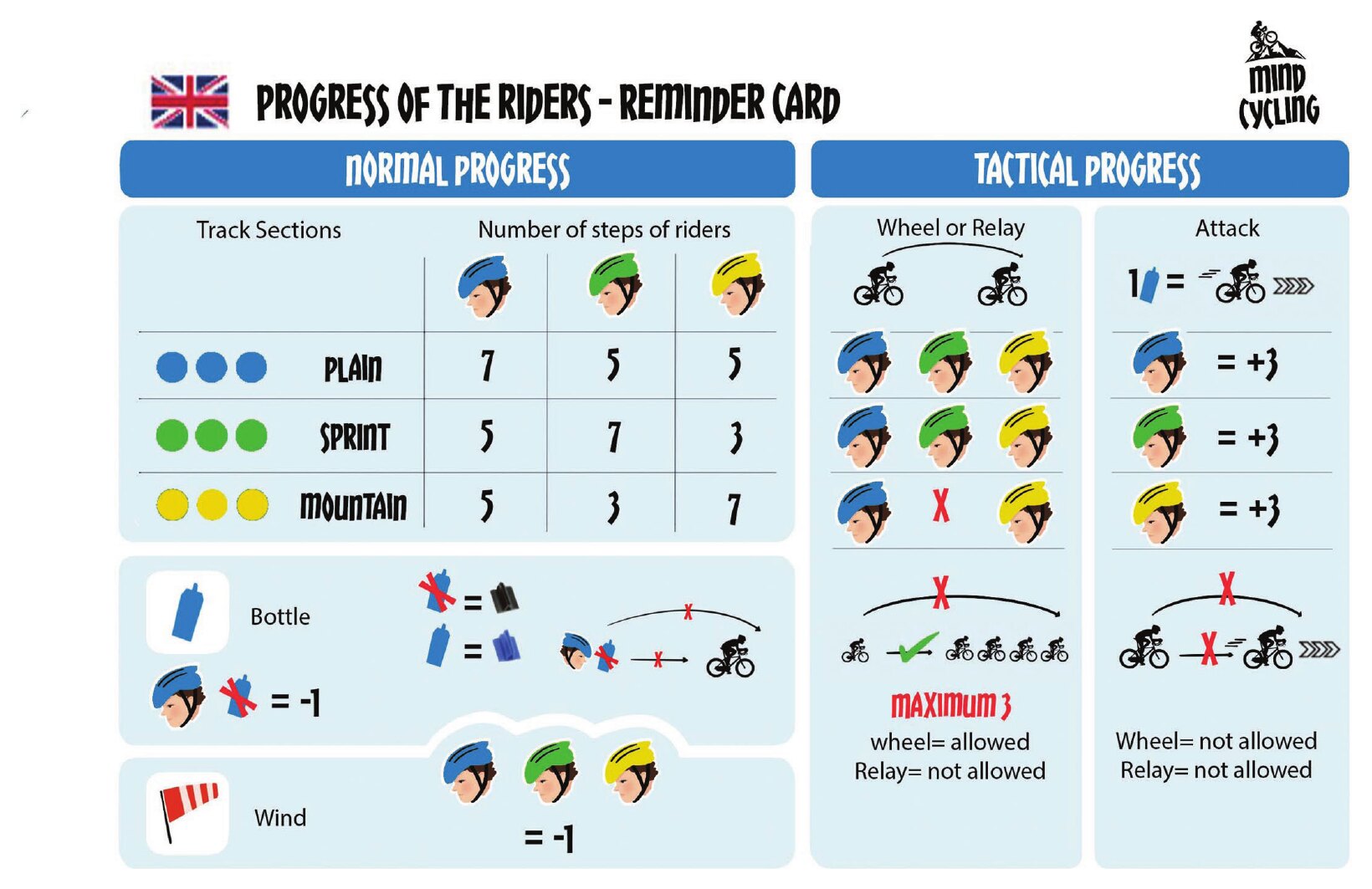
The number of squares depends on the rider type and the section he is in at the start of his turn. Each has his own terrain: the rouleur the flat, the sprinter the sprint, the climber the climb.
You may move less than the maximum. That is what opens the decisions: staying behind someone, or not taking the wind.
| Flat | Sprint | Climb | |
|---|---|---|---|
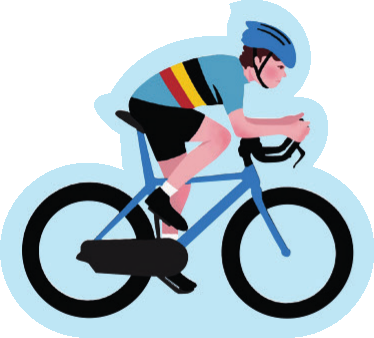 Rouleurblue helmet | 7 | 5 | 5 |
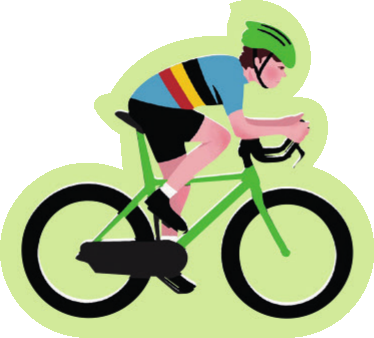 Sprintergreen helmet | 5 | 7 | 3 |
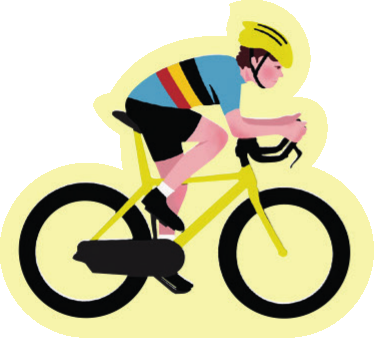 Climberyellow helmet | 5 | 3 | 7 |
 Into the wind: one square less−1 | |||
The wind
The wind
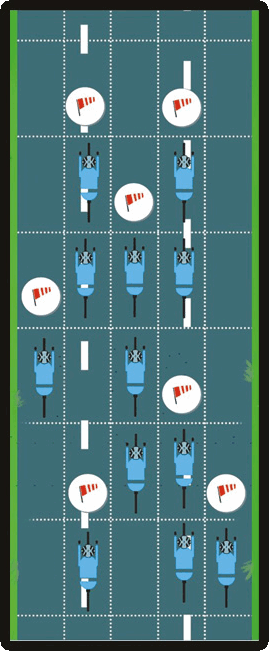
In the base version the wind always comes head-on. A rider takes the wind when the square right in front of him is empty. A diagonal square gives no shelter.
Whoever takes the wind loses one square that turn. Before each turn, a wind token is placed in front of every rider concerned, as a reminder.
The train: wheel and relay
The train: wheel and relay
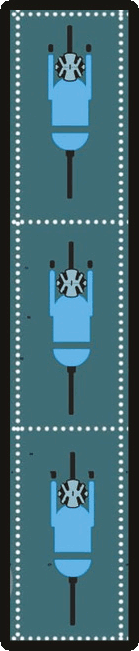
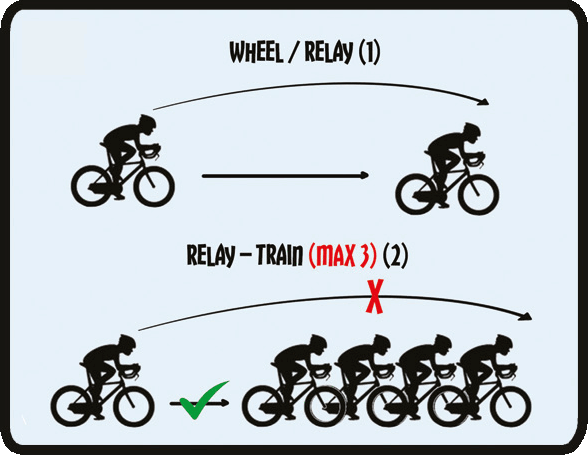
A train is two or more riders one behind the other, with no gap, in the same lane. When a rider in the train moves, the one right behind may, immediately and with priority:
- Take the wheel
- move to the square right behind him.
- Take the relay
- move to the square right in front of him, and lead the train.
- Decline
- and make a normal move.
The wheel and the relay are not limited by the rider’s capacity: a climber on the flat, who would do 4 squares alone into the wind, does 6 in the wheel of a rouleur leading into the wind, and 7 if that rouleur is sheltered himself. That is the heart of the game: a slow rider moves at the speed of the train.
The relay is only possible if the train has no more than three riders; from the fourth, you can only take the wheel. A rider who takes the wheel or the relay stays in his train: you only join another train with a normal move.
On the climb, the sprinter can neither take the wheel nor the relay. Nobody takes the wheel of a rider who attacks, nor of a rider crossing the finish line.
Energy: the bottle, the attack, fatigue
Energy: the bottle, the attack, fatigue
The base shows energy: black base, no bottle; blue base, one bottle. At the start, only the rouleurs have a bottle.
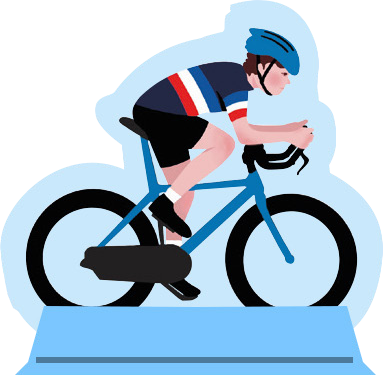 Blue base: one bottle
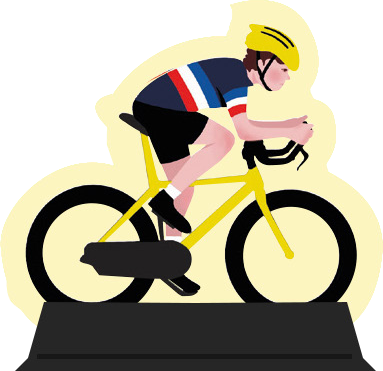 Black base: no bottle
The rouleur can hand his bottle to a team-mate in the square right behind him. It costs no turn: the two swap bases. You never give a bottle to an opponent.
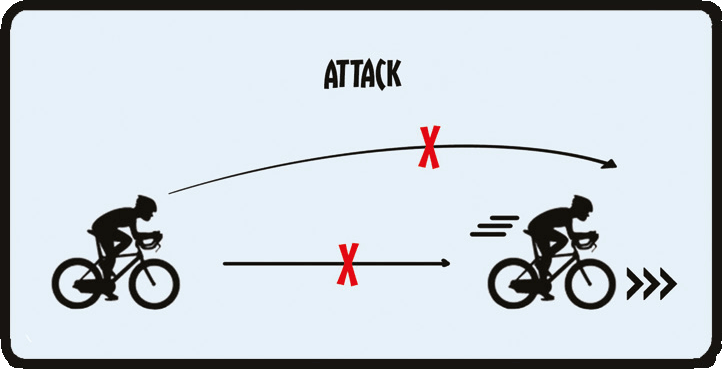
Attacking means spending the bottle to move three extra squares, once, and only in your section: the sprinter in the sprint, the climber on the climb, the rouleur on the flat. A rider who attacks breaks the train behind him: nobody can take his wheel.
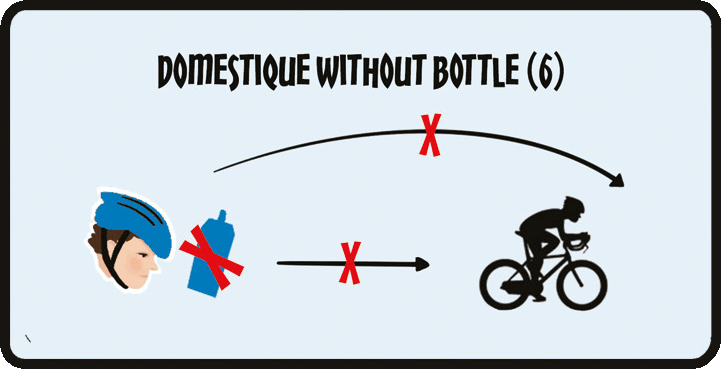
A rouleur with no bottle left has done his job as a domestique: he is tired. He loses one square every turn and can no longer take the wheel or the relay, until he picks up a bottle at the feed zone. This applies whether he attacked or gave his bottle away. A sprinter or climber without a bottle is not tired. The rouleur sacrifices himself for his leader, but he is the only one who can refuel with a bottle.
The feed zone and the rocky mountains
The feed zone and the rocky mountains
Before the game, players may place one or two feed zone tokens on the course. A rouleur without a bottle who passes through that square picks up a bottle and is no longer tired. Sprinters and climbers do not refuel.
At the start of the game, players may also place the six rocky mountains on squares of their choice to narrow the road. Nobody can stop or pass there.
The sprint, the climb, the finish
The sprint, the climb, the finish
The sprint section (from the green tab to the next one, or to the finish) acts as an intermediate sprint: the first rider to finish this section wins the best sprinter medal, even if the race goes on. Same logic for the climb and the best climber medal.
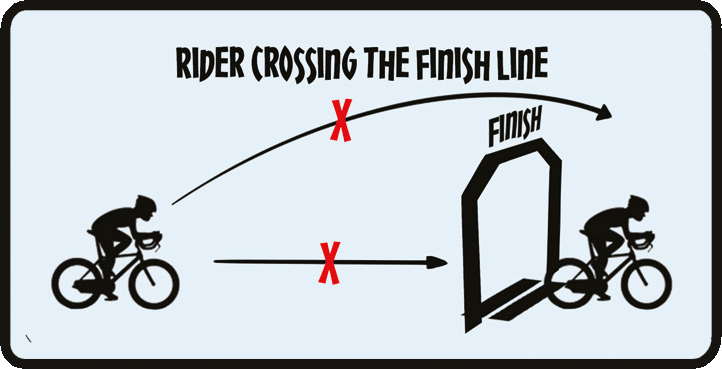
The first to cross the double white line wins the stage and 12 points; the next ones get 11, 10, 9 and so on down to twelfth. Crossing the line breaks the train: nobody takes the wheel of a rider who finishes. The game goes on until every rider has crossed the line.

The expert version: wind direction
The expert version: wind direction
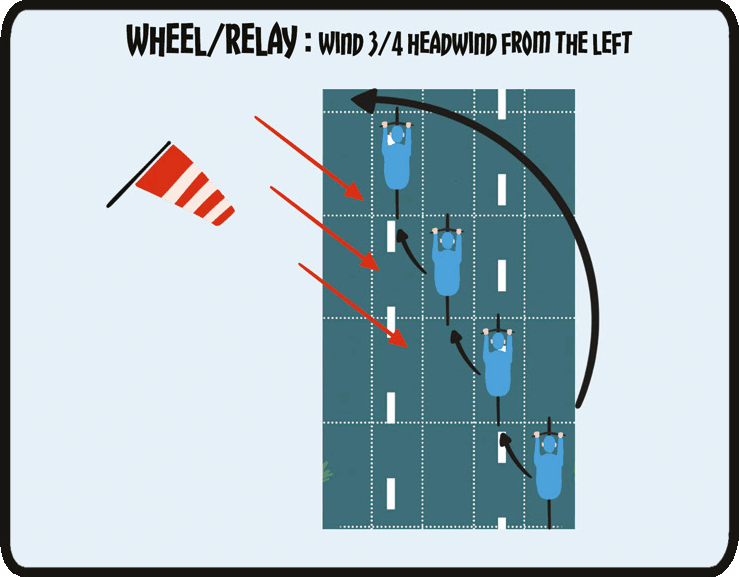
Players choose the wind direction with the large wind token, placed on the board. With a wind from three-quarters front left, a rider takes the wind when the square diagonally in front of him, on the left, is empty.
Whoever takes the wind can neither take the wheel nor the relay; sheltered riders can, diagonally, away from the wind: in an echelon, as on the road.
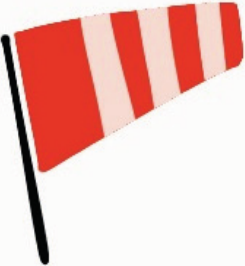 The large wind token sets the direction
The solo version
The solo version
To play alone, set up the stage as for a group: the sections, the finish, the rocky mountains and the feed zone. Then take five riders from one team, lined up side by side before the real start, in the order of your choice. The rules do not change.
The aim is no longer to win medals but to get four riders of the team across the finish line in as few turns as possible. To count them, you can put down a base beside the team’s last rider after each turn. To separate two games, count the squares the fifth rider still has to cover to cross the line.
The solo booklet suggests a course with all three types of section, two feed zone tokens and the six rocky mountains on the climb. Online, on Board Game Arena, the game plays with 1 to 6.
| Game | Turns | Squares left for the fifth |
|---|---|---|
| Game 1better result | 6 | 3 |
| Game 2 | 6 | 6 |
The booklet, in eight languages
The booklet in the box comes in eight languages. Here it is as a PDF, to print or keep on your phone, with the solo version.
Download the bookletPDF, 3.9 MBThe solo versionPDF, 184 KB
The booklet in another language
 Dansk
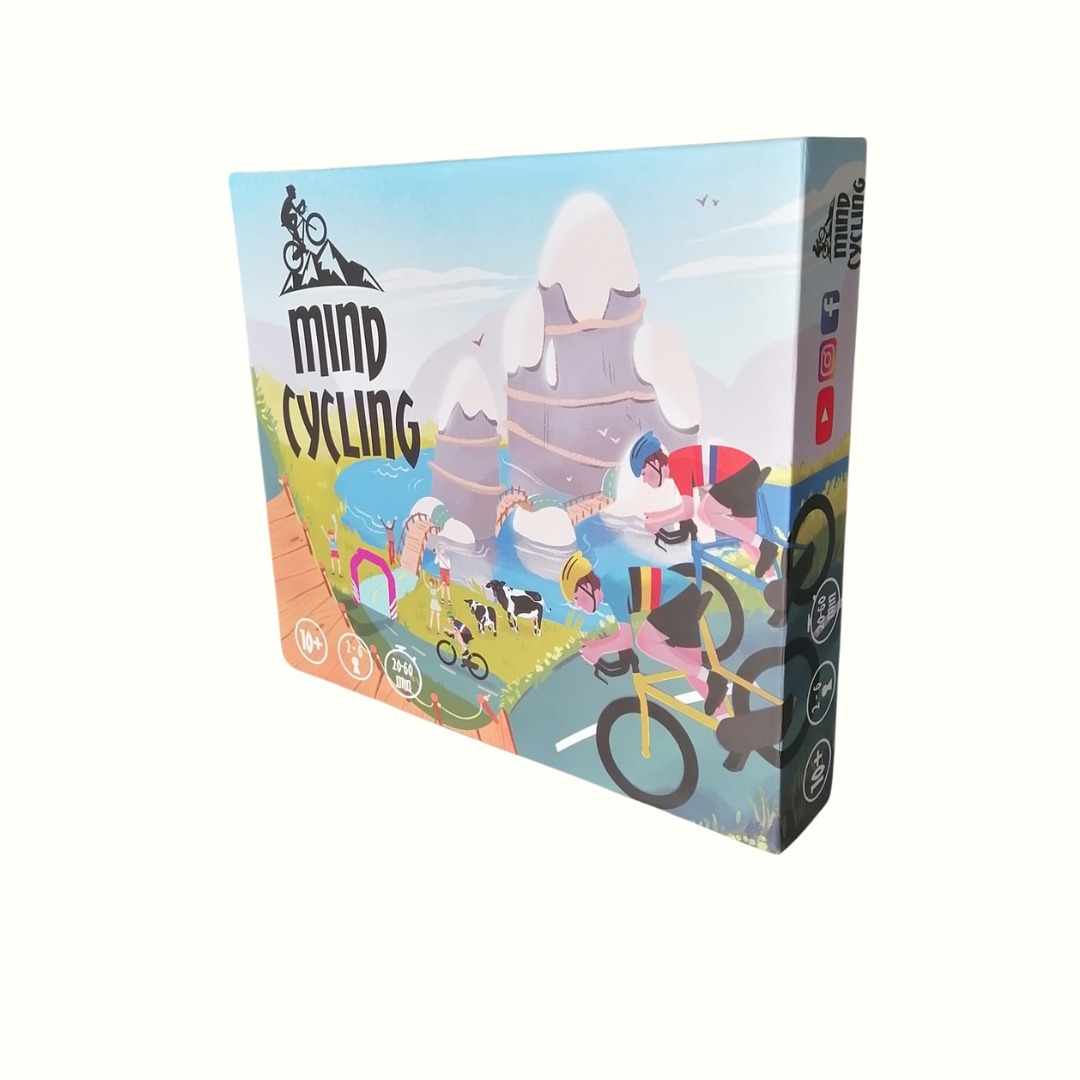
The box
Delivery, payment and returns
Delivery
To a parcel point
Free
in six countries, with  Mondial Relay.
 Belgium
 France
 Netherlands
- Luxembourg
 Spain
 Portugal
Home delivery
- Belgium€6
- France, Netherlands, Luxembourg€8
 Germanyno parcel point€8
- Spain, Portugal€10
 Italyno parcel point€10
- Rest of the European Unionno parcel point€12
 Switzerland,
 United Kingdomno parcel point€23
Shipped from Belgium.
Payment


Payment happens on Stripe’s or PayPal’s secure page. No card details go through this site.
Returns and guarantee
14 days
to change your mind after delivery, with the online withdrawal form.
Return postage is at your expense.
2 years
of legal guarantee of conformity.